Tiki3d
A production 3D Gaussian Splatting authoring and playback platform — explore real-world sites as photoreal point clouds, edit them, and choreograph guided tours, all in the browser.
- Role
- Lead 3D Web Developer
- Client
- Soarscape Ltd
- Year
- 2026
Stack
- PlayCanvas
- 3D Gaussian Splatting
- WebGL
- TypeScript
- Scene Editor
Overview
Tiki3d is the international product line of Soarscape, a B2B SaaS company widening global access to 3D-surveying workflows. As lead 3D web developer I engineered the platform end to end — from the rendering pipeline to the authoring tools to the viewer — and we shipped a live product in roughly four months.
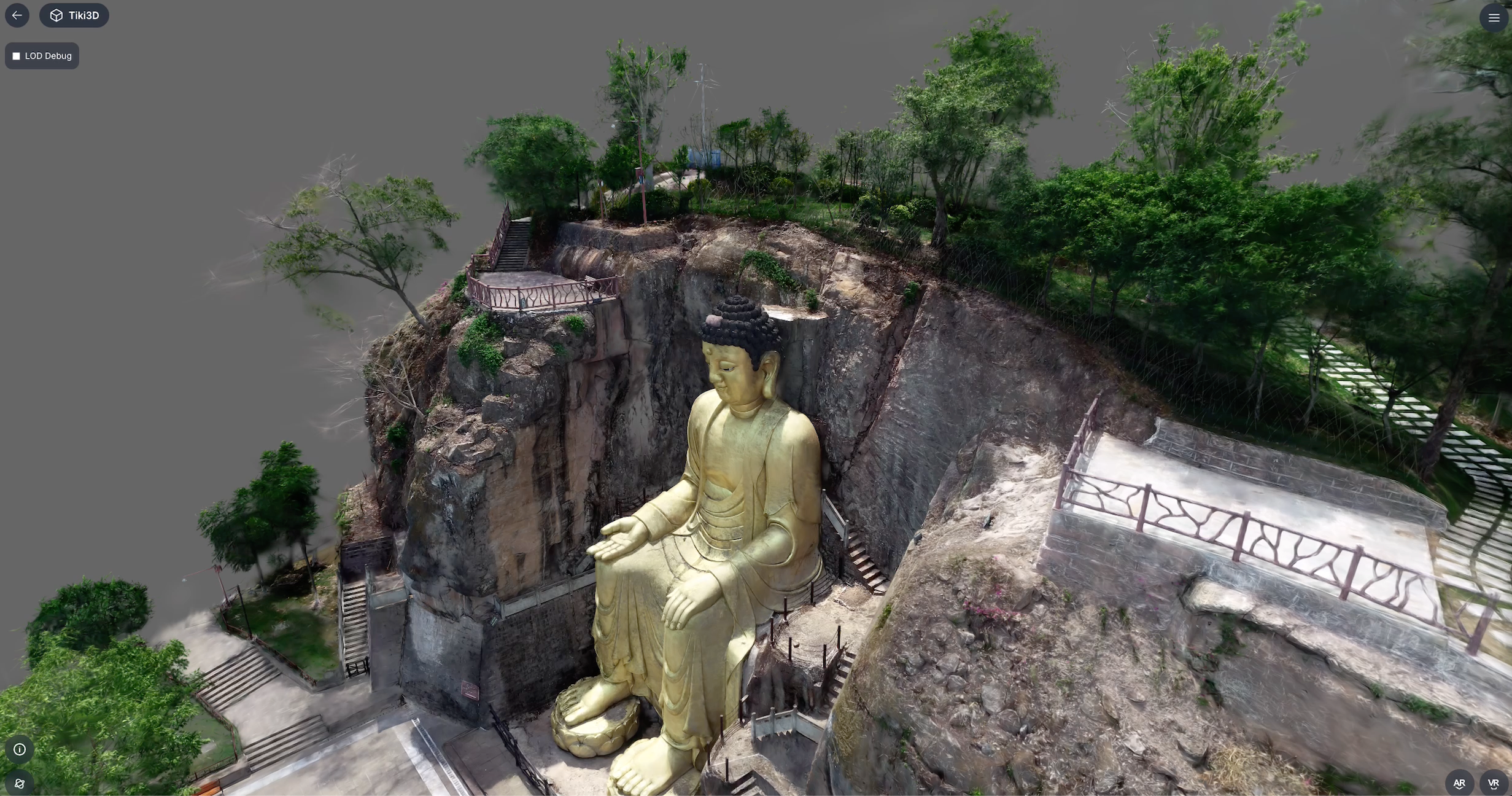
The platform turns captured-from-reality assets into shareable browser experiences. Today it hosts 10+ scenes across multiple countries — power plants, stadiums, heritage sites — the kind of large-scale environments that traditionally only travel as offline DCC files.
What I Built
A unified web stack covering the entire authoring-to-delivery loop, with capabilities rarely shipped on the open web:
- Real-world point-cloud measurement. Click-to-measure distance and dimension tooling that works directly on Gaussian splat scenes — accurate enough for site walkthroughs, light enough for marketing reviews.
- Selective splat editing. Lasso, mask, and refine point clouds in-browser to clean up captures, hide private regions, or isolate areas of interest, with non-destructive history.
- Timeline-based scene editor. A built-in editor for composing camera moves, focal points, and annotations along an eased animation timeline — so non-technical authors can produce cinematic walkthroughs without leaving the browser.
- User-facing guided tours. End viewers experience those authored timelines as smooth, eased playback, making complex 3D environments approachable for first-time users.
Technical Solutions
- Gaussian Splatting on PlayCanvas. A custom rendering pipeline tuned for streaming large splat scenes to mid-range hardware, with progressive load and quality-aware fallbacks.
- Real-time interaction at scale. Selection, transform, and measurement built directly against the splat representation — no proxy mesh, no round-trip through a backend.
- Scene-editor architecture. Timeline, keyframes, and easing implemented as a structured data layer that the viewer and editor both consume, keeping author and end-user experiences in sync.
- Production reliability. Asset versioning, scene metadata, and playback all designed for a multi-tenant client deployment — not a one-off demo.
Why It Matters
Most 3D Gaussian Splatting work today stops at "look, it renders in the browser." Tiki3d goes further — making splat scenes editable, measurable, and authorable, then packaging the result as a tour anyone can open from a link. It's a glimpse of what photoreal 3D on the web becomes when the whole pipeline is treated as a product, not a tech demo.